

Education Centre Web Tour - Biology
The world's fastest land animal, the cheetah, is built for speed. Acceleration from 0 to 84 km/hr in just 3 seconds, with a full speed of 110 km/hr, means that the cheetah can out-perform a sports car!
The scientific name for cheetah is Acinonyx jubatus. The genus name, Acinonyx, is interpreted as 'non-moving claws', referring to the semi-retractable claws. The species name, jubatus, means "maned", referring to the mantle on a young cheetah's back.
The English word, "cheetah", comes from the Hindu word "chita" meaning the "spotted one".
Cheetah Subspecies
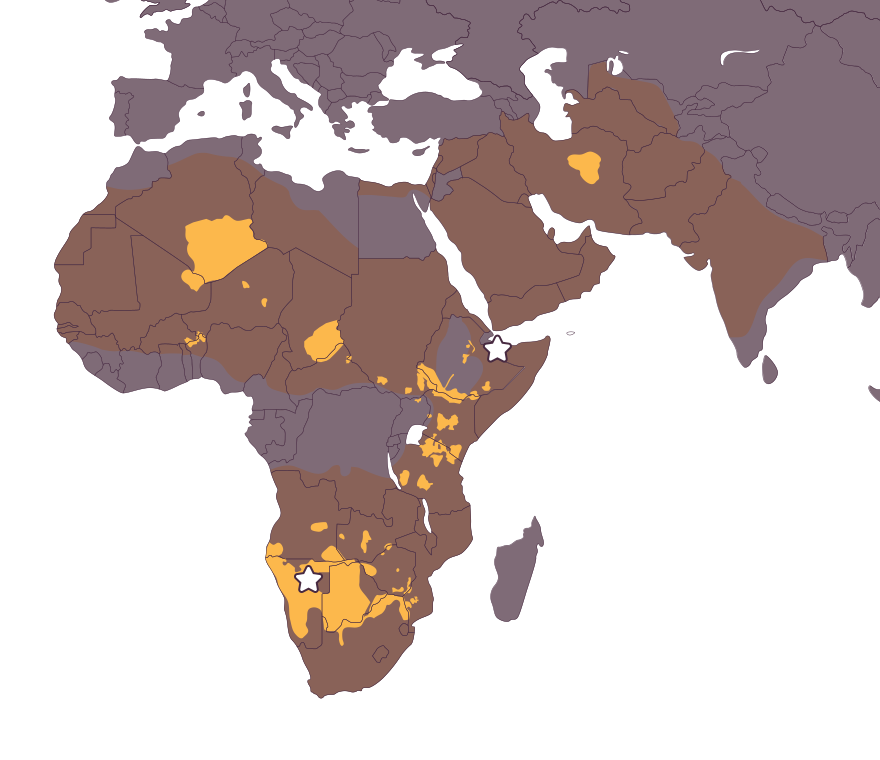
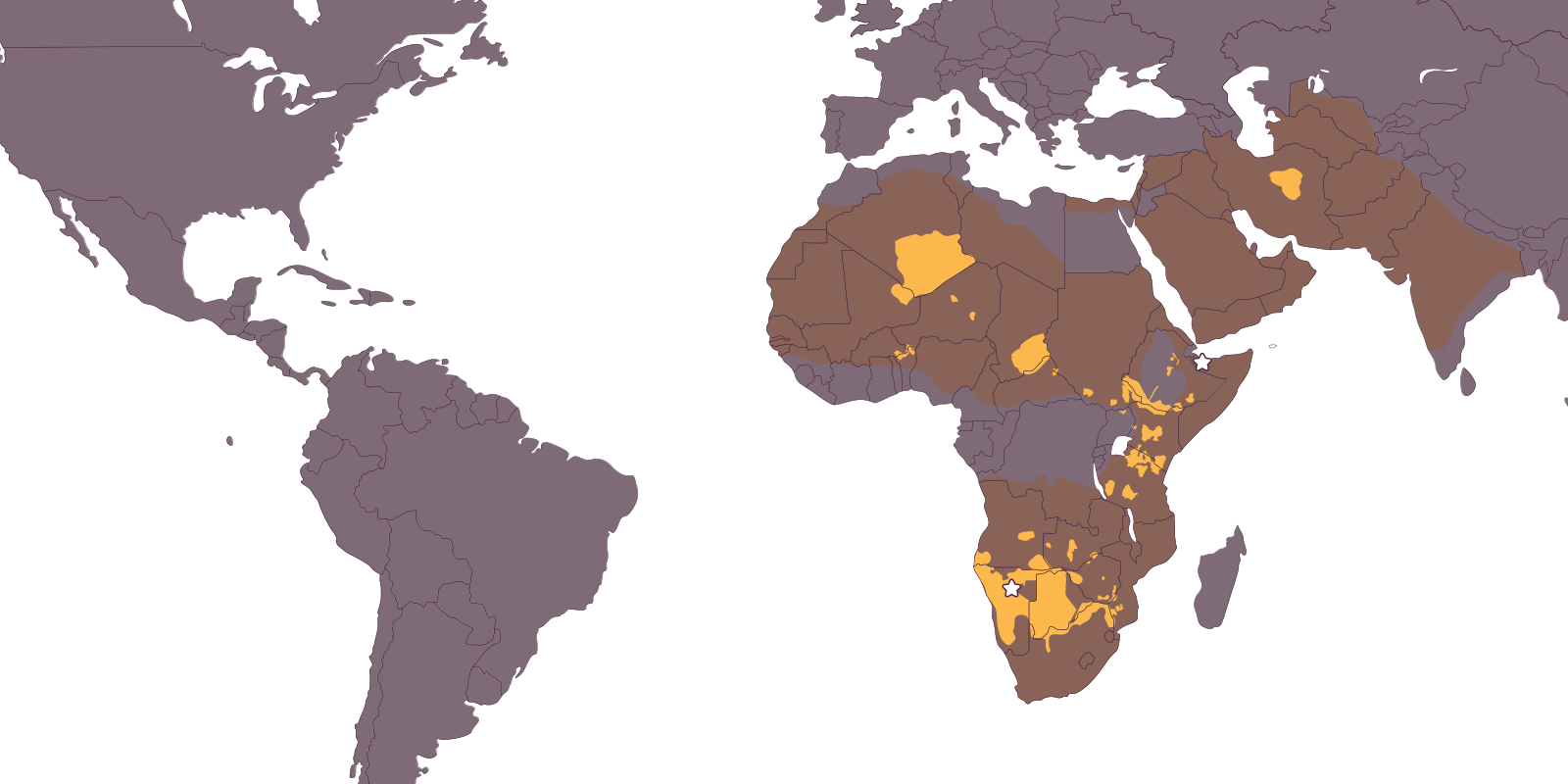
A subspecies is a subdivision of a species, usually based on geographic distribution. Five subspecies are currently recognised by most cheetah researchers. Ongoing research in classical taxonomy and genetics may increase or decrease this number.
- Acinonyx jubatus venaticus subspecies live in northern Africa and Iran.
- Acinonyx jubatus soemmeringii live in central Africa.
- Acinonyx jubatus hecki live in western Africa.
- Acinonyx jubatus raineyii live in eastern Africa.
- Acinonyx jubatus jubatus live in southern Africa, including Namibia.
Once thought to be a separate subspecies, the king cheetah is no different than any other cheetah. Its coat pattern is just a rare colour variation with stripes versus spots.
How do Cheetahs Differ from other Big Cats?
Cheetahs are markedly different in both anatomy and behaviour from the other 36 species of cats. They are the only species in their genus. Until the 1900's they were often thought to be related to dogs rather than cats. Cheetahs are the only big cats that cannot roar, but they can purr.
They have evolved for speed versus power and aggression. Their bodies are lightweight in comparison to the build of other cats. They rely on their speed and skill for survival.
(For information on secrets of successful hunting, see under life cycle stage 3 below).
Body Built for Strength and Stamina
The cheetah's body is narrow and lightweight with long, slender limbs. Specialised muscles allow a greater swing to the limbs, increasing acceleration.
Body length: 112-135 cm
Weight: 34-54 kg
Shoulder height: 73+ cm
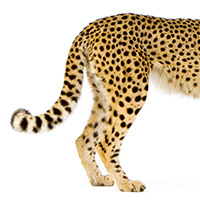
The cheetah's long muscular tail works as a rudder, stabilising and acting as a counter balance to its body weight. This allows sudden sharp turns during high-speed chases.
Built for Speed
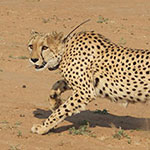
The cheetah's unique body structure, long legs, flexible spine, semi-retractable claws and long tail allow it to achieve the unbelievable top speed of 110 km/hr.
A single stride can be an incredible seven metres, with four strides completed per second. A stride is one cycle with each foot touching the ground. There are two times in one stride when the cheetah's whole body is off the ground; once with all four legs extended and once with all bunched under the body. One foot touches the ground during the other points of the stride.
Feet and Claws
Cheetahs' footpads are hard and less rounded than the other cats. The pads function like tyre treads providing them with increased traction in fast, sharp turns.
The short blunt claws work like the cleats on a track shoe. They grip the ground for traction when running and help increase speed. Cheetahs' claws are semi-retractable, meaning they do not completely retract like the claws of other cats. The foot structure of the cheetah is very dog-like.
The dewclaws of the cheetah are located on the upper inside area of the front foot. These are sharp and frequently used to hook and hold prey.
Flexible Connections
The extreme flexibility of the cheetah's spine is unique. This allows more extension during running, thus making both its stride length and speed possible.
If the spine was stiff and the pectoral and pelvic girdles were firmly attached, the cheetah would not be able to reach 100 km/hr.
The hips (pelvic girdle) pivot to increase the cheetah's stride length. This allows the front and rear legs to stretch farther apart when the body is fully extended. The hips and shoulders move closer together when the feet come under its body. The shoulder blade (pectoral girdle) does not attach to the collarbone, thus allowing the shoulders to move freely. This increases the length of the stride.
Heart and Lungs
The cheetah has a large strong heart that rapidly pumps large amounts of oxygenated blood from the lungs to the muscles to keep them supplied with energy while running.
Large lungs provide adequate oxygen for a cheetah's increased energy needs while pursuing its prey. The cheetah's respiratory rate climbs from 60 to 150 breaths per minute, nearly twice as fast as humans. Cheetahs have enlarged nostrils and sinuses allowing an increase in airflow to the lungs.
High speeds can, however, only be maintained for 400 - 800 metres before exhaustion sets in and the body risks overheating. A cheetah running the 249 km from Otjiwarongo to Windhoek would need to stop to rest more than 311 times. If it could run there without resting, it would take 2 hours and 26 minutes at 110 km/hr.
A Cheetah's Senses
Cheetahs' eyes are high set, forward facing and capable of binocular vision. A cheetah's field of vision is far greater than that of humans (210 degrees versus 140).
Like all big cats, their pupils are round. Smaller cat species have diamond shaped pupils. The retina, the lining in the back of the eye, has more cones and fewer rods than other cats. Rods and cones enable light and colour to be received by the brain. Cheetahs cannot see as well as other cats at night. They have excellent vision for distant objects and may even see some colours. Cheetahs can see detail to a distance of 5 km, while humans with binoculars would have difficulty seeing the same detail.
Although they rely primarily on sight, cheetahs have excellent hearing. They are able to hear the slightest sound and high frequencies. Human ears cannot detect many of the sounds that are heard by cheetahs. The cheetah's ears are small and round. A black patch of soft fur behind each ear is believed to be an adaptation to resemble a pair of eyes.
Cheetah Jaws and Teeth
The cheetah's teeth are adapted to support their eating style. By eating fast, cheetahs avoid losing their prey to other predators. Teeth are adapted to rip and tear.
The canines, "eye teeth" or "fangs", are used for gripping and holding while the prey is being suffocated. The cheetah's canines are smaller and less developed than those of the lion or leopard.
The incisors, "front teeth", are used for plucking fur and skinning the carcass. Straight and strong incisors are essential for quick access to the meat of the prey.
The carnassials, "back teeth" or "pre-molars", work in scissor-like fashion and enable the cheetah to shear large pieces of flesh which are quickly swallowed whole. When using these teeth during feeding, cheetahs hold their heads sideways at an angle to the carcass. These blade-like teeth are similar to the lions' and leopards' carnassials. They do not have the same function of chewing meat as those of the jackal or crushing bones like those of the hyena.
Cheetahs' jaws are not as powerful as that of lions' or leopards' jaws. In all cats, powerful muscles move the jaw up and down and provide vice-like strength for gripping prey and ensure correct action of the carnassial teeth.
The tongue is adapted for licking and is covered with small hard spines called papillae. The papillae act like a rasp, removing the meat from the bones of the prey. The rough tongue feels similar to the texture of sandpaper.
Spots and Stripes
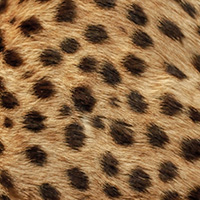
Adult cheetahs are easily distinguished from other cats by their coat patterns. The colour and spots are a form of camouflage. This helps cheetahs hunt prey and hide from other predators. Camouflage is a feature that blends and hides an animal in its environment. It includes the animal's coat pattern or colour, smell, or the noises it makes.
Distinctive black tear stripes run from the eyes to the mouth. The stripes are thought to protect the eyes from the sun's glare. It is believed they have the same function as a riflescope, helping cheetahs focus on their prey.
Keeping the fur clean is an important part of a cheetah's life. Family members spend many hours grooming each other with their tongues. This behaviour aids in the social bonding of a cheetah group.
THE CYCLE OF LIFE
There are four stages in the life cycle of the cheetah.
1. Stage 1: 90 to 95 days pregnancy (gestation and birth).
2. Stage 2: 6 weeks to 18 months (leaving the den, play, learning to hunt).
3. Stage 3: 18 to 22 months (leaving mother, successful hunts).
4. Stage 4: adult life (adult living, mating).
Life Cycle Stage 1
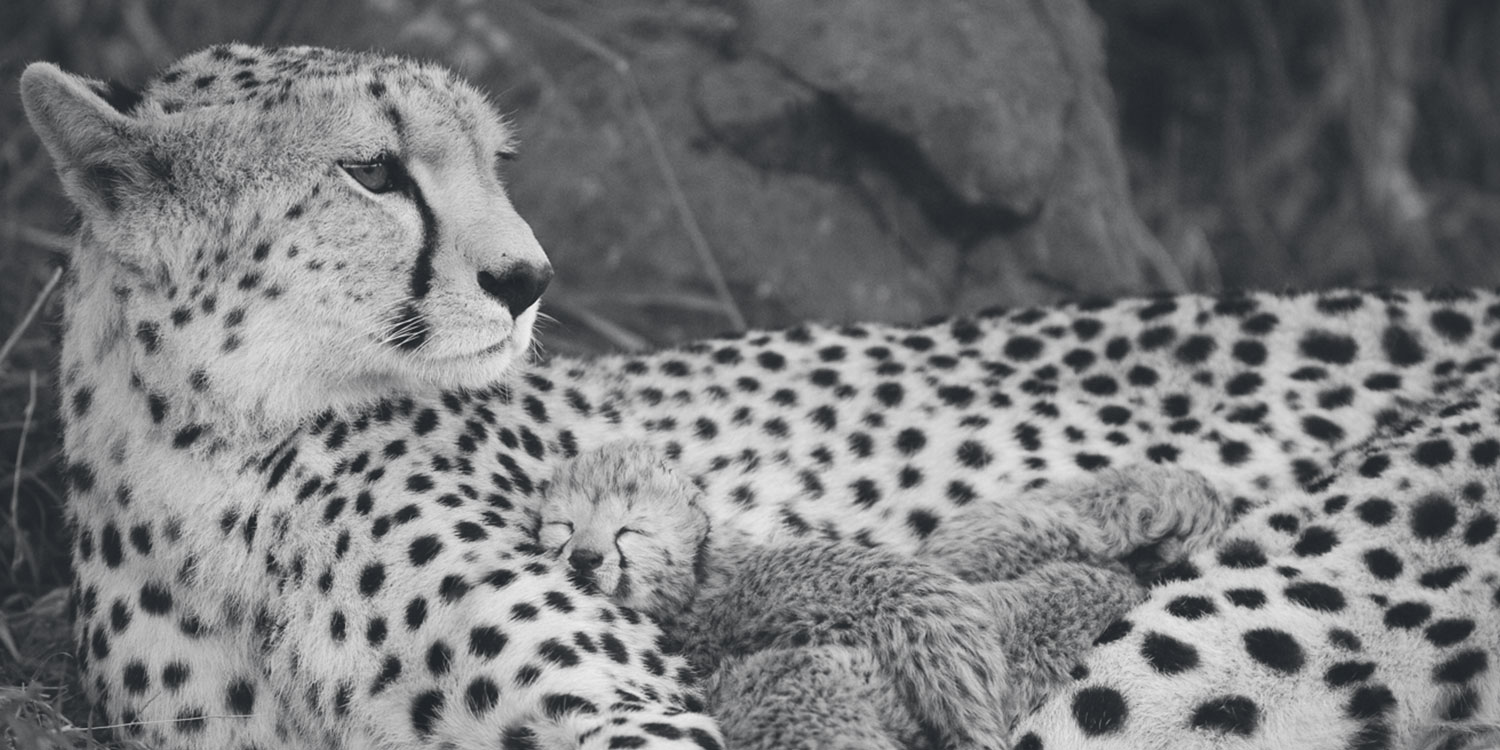
The female's gestation period lasts 90 to 95 days. This means she is pregnant for about three months. Shortly before she is ready to give birth the mother makes a den in a quiet hidden spot. She chooses her location in the tall grass, thick undergrowth or near a clump of rocks.
A cheetah gives birth to an average of five to six cubs. Each cub weighs between 250 and 425 grams. Cubs are born completely helpless and with their eyes closed, but they develop rapidly. Scent and touch are used to find their mother's nipples to suckle.
They start crawling around the nest area at four to ten days when their eyes begin to open. At three weeks their teeth break through the gums.
A mother cheetah will frequently move her litter. This prevents a build-up of scent at the den site, which may lead other predators to the cubs. She carries very young cubs in her jaws.
The cubs are very vulnerable to lions, hyenas and other predators when the female leaves them alone. When hunting she may be away for up to 48 hours. In Tanzania's Serengeti National Park, 90% of all cubs do not reach the age of 3 months! Other causes of death are abandonment when prey is scarce, exposure due to low temperatures or grass fires.
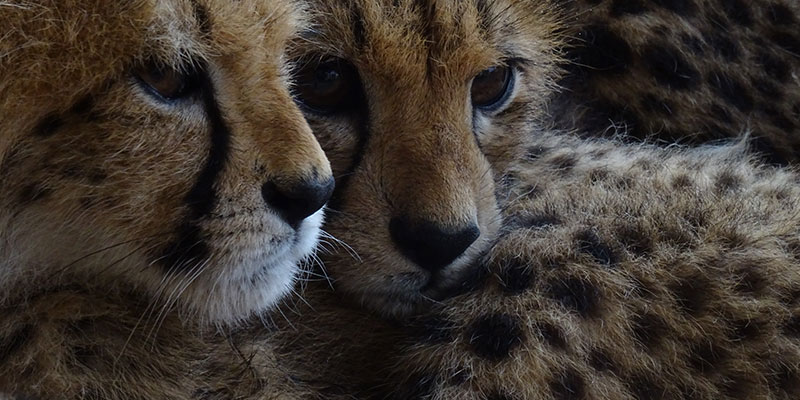
Until three months of age cheetah cubs have a thick silvery-grey mantle down their back. The mantle helps camouflage the cubs by blending them into the shadows and grass. It also provides protection from sun and rain.
With their mantle cubs look like an aggressive animal called a honey badger. This may deter predators such as lions, hyenas and eagles from attempting to kill them. This is known as "mimicry".
Life Cycle Stage 2
At 1½ to 2 months of age, the cubs leave the safety of the den to accompany their mother. They are very vulnerable as they are not able to defend themselves.
They stop drinking their mother's milk at 3 to 4 months of age. They start eating meat and learning to hunt. The games they play and the experiences they have during this stage will teach them skills needed to survive on their own. The tail is thought to be a signalling device, helping young cheetahs follow their mothers in tall grass. The tip may be black or white in colour.
Cheetahs at play
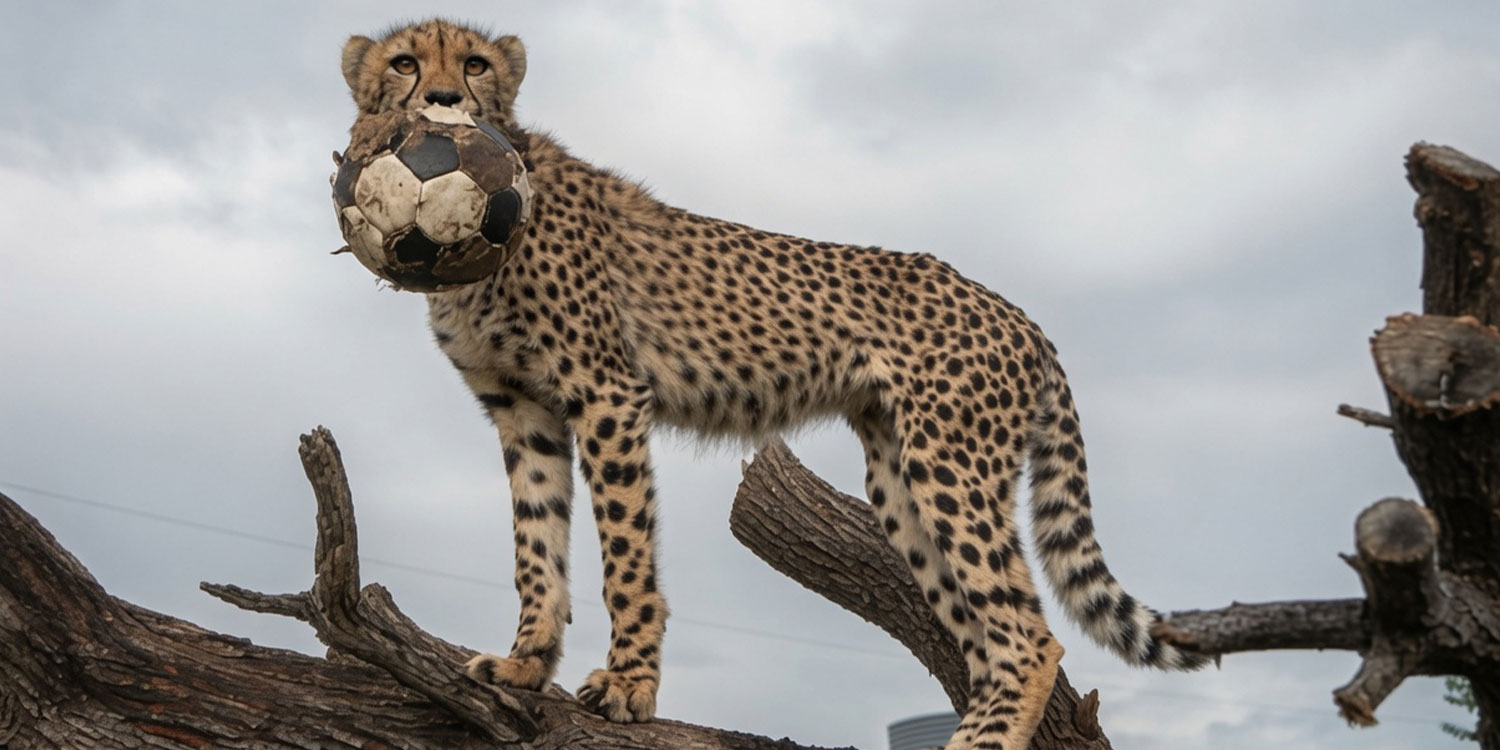
Young cheetahs explore and investigate their surroundings. In play behaviour they stalk, pounce, chase, box, wrestle and play tug-of-war. Play behaviour helps them develop strength and body coordination. Play is important for learning and practising hunting skills.
They also trip each other from the rear. This is typical behaviour when catching prey. They chase and try to catch many different species of small birds, such as francolin or guinea fowl.
Learning to hunt
Cheetahs watch their mother hunt. The mother brings live prey, such as a young gazelle, to the 9 to 12 month old cubs. She releases it in front of them and the cubs attempt to catch it. This allows the cubs to practice their hunting skills while still under her supervision. Accurate timing and coordination during a hunt are important for their future survival.
Life Cycle Stage 3
Stage three begins at the age of 18 to 22 months when the cubs have grown to sub-adults and leave their mother. The sub-adults will remain together for up to six more months. At first their success rate at capturing prey is poor.
Secrets of Successful Hunting
To achieve a successful hunt a sequence of behaviours occurs. If the sequence is interrupted the hunt will be abandoned. If it is successful, the cheetah may not have to hunt again for several days. The sequence consists of several parts:
- Visual contact - The cheetah climbs termite mounds or trees as vantage points to locate potential prey.
- Approaching prey - The cheetah may either select and stalk prey from a hidden position or approach the prey at a walk or slow run. The cheetah takes smaller prey than other similar sized cats.
- Chase - The cheetah bursts into full speed after its prey. If the chase is unsuccessful, the cheetah will need to rest before another hunt is attempted.
- Trip - Running at full speed, the cheetah uses its front foot and dewclaw to strike at the hind legs of its prey, tripping and knocking it down.
- Killing prey - Prey is killed by suffocation when the cheetah takes hold of the throat, closing off the windpipe. Their strong jaws lock around the throat of the prey in what is called a "strangulation hold", which can last up to 20 minutes.
- Rest - A cheetah will sometimes be too exhausted to eat after a high-speed chase. It may rest up to 30 minutes before eating or hunting again.
- Feeding - Cheetahs often drag their kills to a shaded area and begin eating the hindquarters of the carcass.
Cheetahs are diurnal, hunting mornings and early evenings. Diurnal refers to animals that are active during daylight hours. They rely on their sight to find prey. They spend most of the day resting under shady trees or on termite mounds. Night hunting is only done during a bright moon.
Life Cycle Stage 4
In stage 4 cheetahs become sexually mature. Although they are mature at 16 to 18 months, most do not breed until they are three to five years old.
At 20-30 months of age, females leave their littermates to find suitable mates and start their own families. They raise their families on their own without the help of the male.
Males usually do not breed until they are 4 to 5 years of age, and dominant in a territory. They live alone or brothers form permanent groups called "coalitions". These groups stay together for life, claim territories, hunt and find mates together.
Finding a mate
The range of a female offspring may partially overlap that of her mother. Namibian cheetahs are more social than those reported in other countries. Females are often seen with multiple adults and cubs of varying ages.
Female cheetahs are polyoestrous, which means there is no regular breeding season. If not bred, females come into heat (oestrus) several times a year. Oestrus means they are ready to breed. If cubs are lost to predators, females soon come into oestrus again.
Smell, sound and behavioural stimuli attract males to females. Female cheetahs leave a scent trail by releasing sex hormones in urine and faeces. They mark trees and bushes. This behaviour increases during courtship.
When courtship takes place, males will follow females closely and mock fighting may be observed.
When a female is ready to mate she adopts a receptive posture. The male mounts the female, bites the back of her neck, and breeding takes place. When the male dismounts the female she rolls over on her back and swats at him.
Mating will take place for one to several days and ends when the male loses interest in the female and leaves. Males do not help raise the cubs.
Living Fast - Dying Young
A coalition consists of male siblings of the same litter or young unrelated males that have joined together. A hierarchy develops among the males within a coalition.
Dominant breeding males usually chase young males away from their birth range. They may establish home ranges more than 100 km away. A coalition is more successful in acquiring and holding territories and in defending kills than single males. This competition can result in mortality among males.
Mortality
The cheetah's life span is poorly documented in the wild. A radio collared cheetah lived to be almost 7 years of age in Tanzania's Serengeti National Park and one of CCF's radio collared cheetahs in Namibia lived for over 10 years.
Adult mortality is one of the most significant limiting factors for cheetah population growth and survival. Poaching, competition with large predators and farmers, and loss of habitat and prey are factors attributing to early death.
Although cub deaths are high, cheetahs have evolved to reproduce rapidly in response to this mortality.
Vocalizations
Cheetahs have many unusual vocalizations. These are some of the most common calls made by cheetahs.
- Purr - As with domestic cats this sound indicates a friendly and contented mood.
- Chirp - A high-pitched bird-like chirp is used by a mother calling her cubs, cheetahs greeting each other and during courtship. These calls can be heard over a long distance. The intensity of the chirp increases with excitement.
- Stutter Call - A male on the trail of a female in heat will use this call. It is also used by a mother asking her cubs to follow closely.
- Growling, Hissing - These sounds are associated with defence and aggression. With these vocalizations, they may lunge and slap the ground, alternately crouching and growling.
- Bleating - This sound expresses distress and is similar to meowing.
- Ihn-Ihn - This call is used by a mother to summon her young and alternates with chirping.
Genetic Confusion
Genes are the components of living cells that pass down inherited characteristics such as brown eyes or curly hair in humans.
Genetic diversity is the variety of genes in an organism or in a population. Diversity increases the likelihood that a given species can adapt and survive catastrophes such as sudden environmental changes or exposure.
How Does this Relate to the Cheetah?
Cheetahs are very closely related and have a low genetic diversity. This is due to the drastic reduction in their numbers when the population bottleneck occurred. This inbreeding and low genetic diversity may cause abnormalities.
Abnormalities
CCF collects data to monitor cheetah genetics, viruses, physical qualities and reproduction. Body measurements, blood and skin samples help evaluate overall health. CCF has recorded the following abnormalities in wild Namibian cheetahs:
- Crowded lower incisors - Cheetahs use their front teeth (incisors) to rapidly skin their prey. Some cheetahs have very crowded and crooked front teeth. This abnormality decreases the amount of meat the cheetah can quickly eat before another predator steals its kill.
- Focal palatine erosion - This abnormality occurs when the lower molars (back teeth) damage and break through the upper palate (roof of mouth). Dental impressions and skull X-rays allow CCF to relate problems with information on genetics, health, diet and geographical origin of affected cheetahs. Palatine erosion is reported in both captive and wild cheetahs and can lead to fatal infection.
- Abnormal sperm - A high frequency of sperm abnormalities (71%) first alerted researchers to the genetic problems of cheetahs. Cheetahs have a very low sperm count - 10 times lower than a domestic cat. Sperm abnormalities usually indicate a high level of inbreeding in the population. Cheetahs breed normally despite this problem and long-term monitoring will follow their success rate.
- Birth defects - Congenital (genetic) birth defects, such as six legged and two-headed cubs, are often reported in cheetahs and cause high infant mortality. Defects are a result of low genetic diversity. This problem is also recorded in other inbred species.
- Kinked tails - Crooked tails have been recorded in 19% of the Namibian cheetahs evaluated since 1995. This is the first documentation of this abnormality in wild cheetahs and could be linked to a lack of genetic diversity.