

Frequently Asked Questions
(1 - 25 of 211)
| Question: |
How do cheetahs sweat? |
| Answer: |
Cheetah’s just like other cats do have sweat glands in their paws but they also thermo regulate via a phenomena called thermo-polypnea, basically panting – similar to dogs (the moist lining of the lungs serves as a evaporating surface when panting takes place. Also blood vessels dilate nearer the surface of the face and ears to reduce body temperature). |
| Question: |
1. why would frequent copulation be beneficial? 2. why do you think the cheetah mates fewer times but has a longer oestrus period than some of the larger cats? |
| Answer: |
1. Cheetahs are one cat species that demonstrate induced ovulation. Follicles on the cheetah ovary contain oocytes (eggs). These follicles and internal oocytes mature during the estrous cycle and the follicles produce estrogen. Estrogen causes the females to show receptivity to males (estrus or heat) and allow mating to occur. The ovary only releases, or ovulates, an oocyte when the female physiologically is induced to do so. This is done by the physical stimulus of mating. The penetration of the penis into the female tract causes a cascade effect and eventual release of a protein hormone called luteinizing hormone (LH) from a gland in the female's brain. This hormone then causes the follicles on the ovary to rupture, releasing the mature eggs into the female tract. Repeated mechanical stimulation causes release of higher LH concentrations (a stronger surge) from the brain. Very rarely (less than 2%) are spontaneous ovulations observed in the cheetah, due to very high estrogen levels that then cause the release of LH. This mechanical stimulation can be mimicked in domestic cat models (also induced ovulators) by repeated penetration of the vagina with a swab. We also can stimulate follicular growth and ovulation with hormones that we give via injections. 2. Cheetahs are one cat species that demonstrate induced ovulation. Follicles on the cheetah ovary contain oocytes (eggs). These follicles and internal oocytes mature during the estrous cycle and the follicles produce estrogen. Estrogen causes the females to show receptivity to males (estrus or heat) and allow mating to occur. The ovary only releases, or ovulates, an oocyte when the female physiologically is induced to do so. This is done by the physical stimulus of mating. The penetration of the penis into the female tract causes a cascade effect and eventual release of a protein hormone called luteinizing hormone (LH) from a gland in the female's brain. This hormone then causes the follicles on the ovary to rupture, releasing the mature eggs into the female tract. Repeated mechanical stimulation causes release of higher LH concentrations (a stronger surge) from the brain. Very rarely (less than 2%) are spontaneous ovulations observed in the cheetah, due to very high estrogen levels that then cause the release of LH. This mechanical stimulation can be mimicked in domestic cat models (also induced ovulators) by repeated penetration of the vagina with a swab. We also can stimulate follicular growth and ovulation with hormones that we give via injections. |
| Question: |
What is the word for cheetah in other languages? |
| Answer: |
Namibia has many ethnic groups living in it and they all have their own language. There is no Namibian language as such but several local languages have 'click' sounds. Here are the words for cheetah I was able to find out: Afrikaans: Jagluiperd Oshiwambo: Etotongwe Damara/Nama: !Arub (the sign in front of the A represents a click sound) German: Gepard |
| Question: |
Hi i have 4 questions (lots, sorry) i cannot find answers to, could you please help? 1. do cheetahs see in black and white or colour? 2. Where is a cheetah's blind spots? 3. How far can they see (distance of sight)? 4. How good/bad is their night vision? THANKS |
| Answer: |
Cheetahs' eyes are high set, forward facing and capable of binocular vision. A cheetah's field of vision is far greater than that of humans (210 degrees versus 140). Like all big cats, their pupils are round. Smaller cat species have diamond shaped pupils. The retina, the lining in the back of the eye, has more cones and fewer rods than other cats. Rods and cones enable light and colour to be received by the brain. Cheetahs cannot see as well as other cats at night. They have excellent vision for distant objects and may even see some colours. Cheetahs can see detail to a distance of 5 km, while humans with binoculars would have difficulty seeing the same detail. Although they rely primarily on sight, cheetahs have excellent hearing. They are able to hear the slightest sound and high frequencies. Human ears cannot detect many of the sounds that are heard by cheetahs. The cheetah's ears are small and round. A black patch of soft fur behind each ear is believed to be an adaptation to resemble a pair of eyes. This and more information about cheetahs is available at our Education Center's Virtual Tour. |
| Question: |
On the BBC website I heard about your project of using guarding dogs to protect domestic livestock, in order to create a more peaceful coexistence between predators and people. I think this is a very ingenious initiative and hope the success of the project as reported by the BBC and your website continues. I have one question though to which I could not find the answer on your website. The dogs that you give to the shepherds, are they fertile, or do you have any other method of controlling the dogs from breeding? If not, how do you make sure the dogs will not become an uncontrollable problem? Although often introduced with good intentions, introduced species have often proven to become a pest in the long run. The Nile Perch in many African lakes is an example, as are many introduced species in Australia. I hope you can answer my question, and in any circumstance, I wish you lots of luck with your project. Maybe sometime in the future I will be lucky enough to visit your project on location or spend time as a volunteer. |
| Answer: |
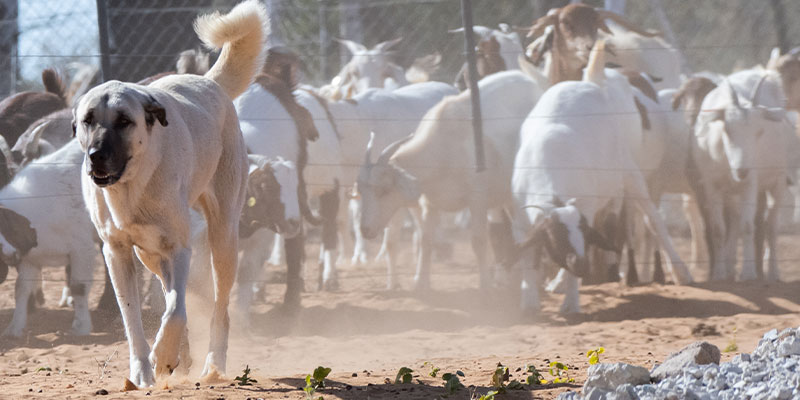
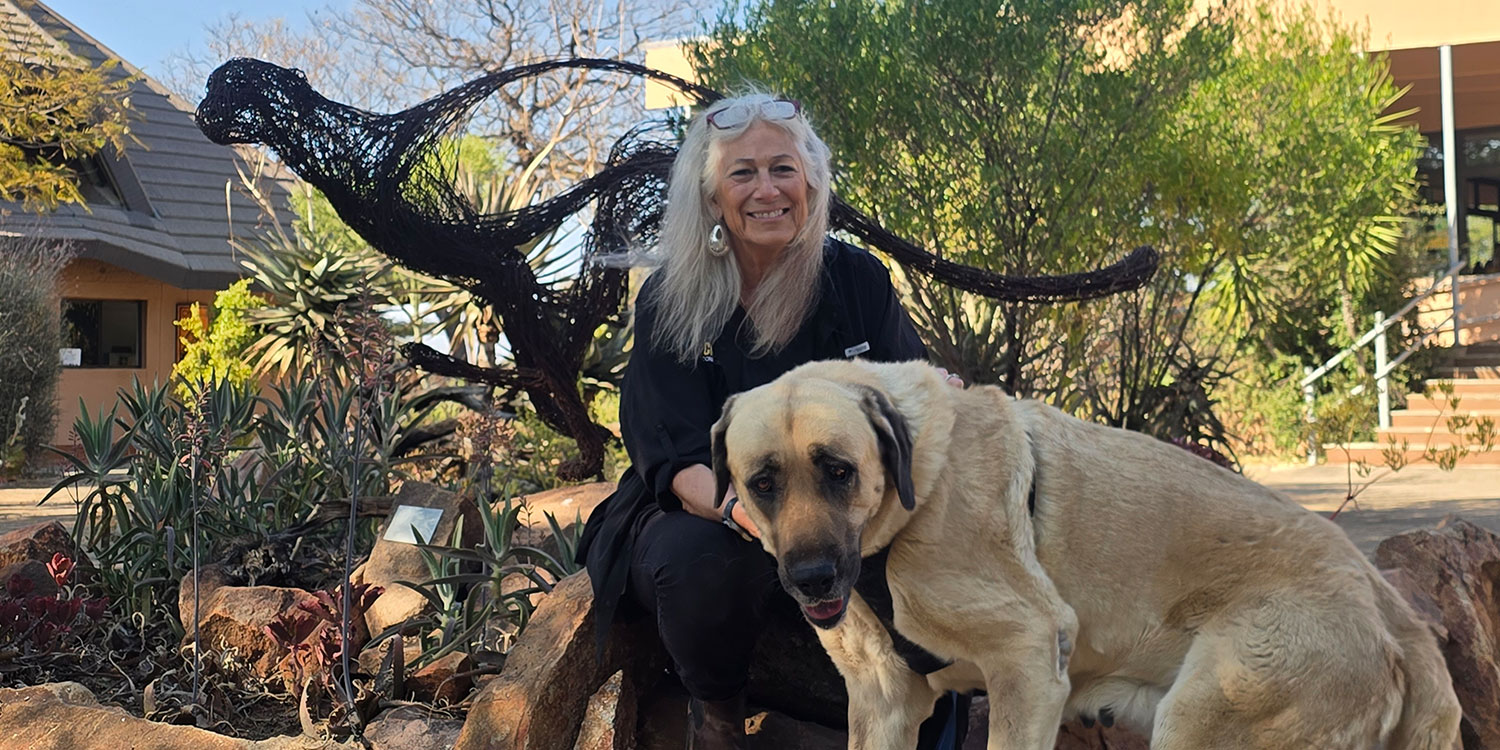
Thanks for your interest and your very valid concerns. Our livestock guarding dogs are all spayed and neutered before they go to work on farms. Only our breeding males and females, which stay at CCF, are fertile. |
| Question: |
Dear Sir/Madam, On the BBC website I heard about your project of using guarding dogs to protect domestic livestock, in order to create a more peaceful coexistence between predators and people. I think this is a very ingenious initiative and hope the success of the project as reported by the BBC and your website continues. I have one question though to which I could not find the answer on your website. The dogs that you give to the shepherds, are they fertile, or do you have any other method of controlling the dogs from breeding? If not, how do you make sure the dogs will not become an uncontrollable problem? Although often introduced with good intentions, introduced species have often proven to become a pest in the long run. The Nile Perch in many African lakes is an example, as are many introduced species in Australia. I hope you can answer my question, and in any circumstance, I wish you lots of luck with your project. Maybe sometime in the future I will be lucky enough to visit your project on location or spend time as a volunteer. Sincerely, Dolf Andringa. |
| Answer: |
Thanks for your interest and your very valid concerns. Our livestock guarding dogs are all spayed and neutered before they go to work on farms. Only our breeding males and females, which stay at CCF, are fertile. |
| Question: |
I would like to send a check for a donation.what address should I send it to. I don't give a huge amount but I give many times. |
| Answer: |
Our address for donations is Cheetah Conservation Fund - PO Box 2496 - Alexandria, VA 22301-0496. You can also find it under About CCF - CCF USA. |
| Question: |
who was the author of "general information about the cheetah". i need it for a school project, so if you could send the answer as soon as pssible that would be great. thanx |
| Answer: |
All the information in this web site should be credited to Cheetah Conservation Fund. Thanks for asking! |
| Question: |
Hi there! Thanks a lot for your continued support towards the cheetah conservation. My question is Someone once told me that when many vehicle drive too close to a cheetah,the animal usually begins to roll and change sides meaning that the animal has been disturbed or irritated by the presence of the vehicle.Can u please confirm this?Many thanks.Sam,from Kenya |
| Answer: |
Yes, cheetahs generally do get disturbed by vehicles getting too close to them. The reason is very simple: cheetahs are diurnal animals, meaning that they sleep at night and hunt during the day, as opposed to lions or leopards. A cheetah's day is dedicated to hunting and trying to stay cool when it gets very hot. Getting too close to a cheetah might mean that the cheetah might have to find another resting spot. Also, vehicles might chase away the prey if a cheetah is scanning the landscape for a hunt, and thus, the cheetah might lose a very important meal. |
| Question: |
I saw a tv show nature show in the U.S. and it had a segment on the cheetah in Namibia. The segment focused on the problem of eye damage caused by the brush near farmland and attempts to move the cheetah for their protection. I do not recall the name of the show and have been unable to find it anywhere. Any information on either the show or more specifically, the subject of the show, would be much appreciated. |
| Answer: |
Cheetahs live mainly in grassland savannahs. They prefer habitat which includes some cover in the form of bushes, medium-length grass, trees and small hills. However, in Namibia, this habitat is densely encroached by thornbush due to overgrazing. When cheetahs chase their prey at high speeds, they ocassionally run into this invasive thornbush, resulting in eye damage. To address this problem, CCF launched Bushblok, an initiative aimed at restoring the savannah habitat by harvesting areas affected by bush encroachment. Bushblok is an eco-fuel log that people can use in their fireplaces or for cooking. CCF's Bushblok processing plant was officially opened in 2004 and has created employment for over 50 people. In addition, this project proves to be effective in restoring productive savannahs thus creating direct linkages between biodiversity conservation and economic development. |
| Question: |
Why don't you make a section on your website for kids to volunteer in the US? |
| Answer: |
Although we do not have any volunteer opportunities for kids in the U.S., we do have a Kids4Cheetahs section under the Main Menu (left) that includes information on how kids can help CCF by educating people and raising funds --this section is called Kids@Work. |
| Question: |
what are the chances of the cheetah's long-term survival? |
| Answer: |
If we don't do anything, none, 20 years perhaps. This is why we encourage anyone concerned about our planet and its magnificent animals to support organizations like ours. Donations are what keep us going. Without them, we cannot ensure that the cheetah does not disappear from this Earth. Please visit the section How You Can Help on the left for information. |
| Question: |
If a cheetah cannot find meat will eat eat other things? What other things would it eat? |
| Answer: |
Good question! No, cheetahs are exclusively carnivorous, which means that they only eat meat. This is why our scientific research includes studying habitat and prey base, to ensure that cheetahs have enough food sources, instead of having to enter into conflict with human beings and their domestic animals. |
| Question: |
what are the cheetahs sound adaptations? |
| Answer: |
Cheetahs have many unusual vocalizations. These are some of the most common calls made by cheetahs. Purr - As with domestic cats this sound indicates a friendly and contented mood. Chirp - A high-pitched bird-like chirp is used by a mother calling her cubs, cheetahs greeting each other and during courtship. These calls can be heard over a long distance. The intensity of the chirp increases with excitement. Stutter Call - A male on the trail of a female in heat will use this call. It is also used by a mother asking her cubs to follow closely. Growling, Hissing - These sounds are associated with defence and aggression. With these vocalizations, they may lunge and slap the ground, alternately crouching and growling. Bleating - This sound expresses distress and is similar to meowing. Ihn-Ihn - This call is used by a mother to summon her young and alternates with chirping. For more interesting information about the cheetah, take our Education Center's Virtual Tour by clicking here. |
| Question: |
When do cheetahs have babies? |
| Answer: |
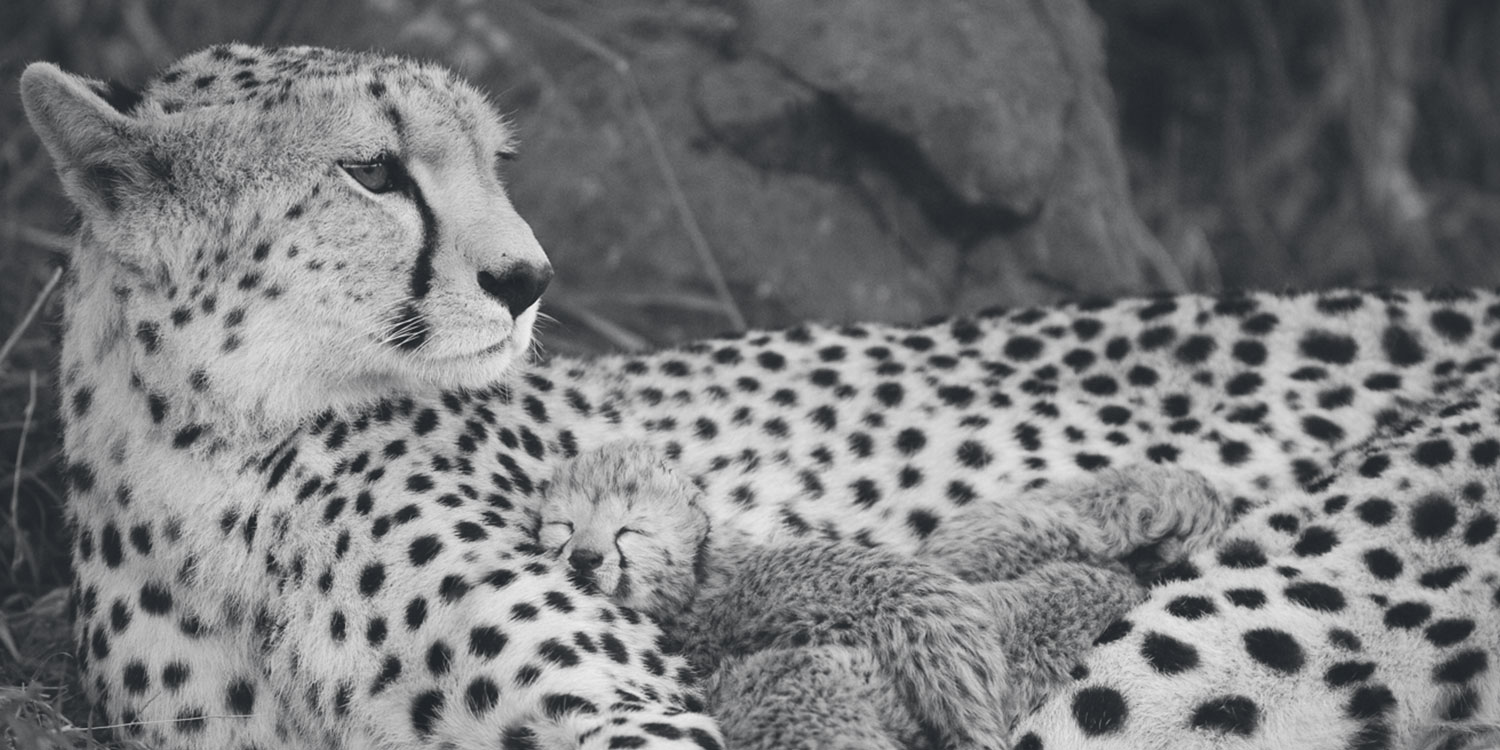
The female's gestation period lasts 90 to 95 days. This means she is pregnant for about three months. Shortly before she is ready to give birth the mother makes a den in a quiet hidden spot. She chooses her location in the tall grass, thick undergrowth or near a clump of rocks. For more information, please visit our section About the Cheetah. |
| Question: |
DO CHEETAHS SWIM? |
| Answer: |
Yes, cheetahs have been known to swim if they need to do so. |
| Question: |
What year was the Cheetah added to the endangered species list? |
| Answer: |
On 1 July 1975, CITES (the Convention on International Trade of Endangered Species) placed the cheetah on Appendix I, making international trade in live cheetah or cheetah products illegal. In the U.S., we are following closely on a proposed Bill that would weaken the already under funded Fish and Wildlife Service (FWS)'s Endangered Species Act programs. These programs protect and recover endangered wildlife, fish and plants. The FWS first listed the cheetah on 2 June 1970, and is currently designated as Vulnerable or Endangered in its entire range. |
| Question: |
Hi i have 2 questions which i am unable to find out why. 1. When a cheetah makes a call for her sister or brother or kids, how do they know by the call that it belongs to the same family.. Example there are 2 cheetahs together and get seperated by zebra or something, they loose each other now they covering ground to find each other, When they doing a call, how would another Cheetah know not to go to that cheetah calling. 2. Why do they have teardrops, whats the purpose. |
| Answer: |
1) Cheetahs, like most animals, have individual calls that they recognize, so they can differentiate between a famliar call versus a strange one. 2) The tear marks on a cheetah's face are thought to protect the eyes from the sun's glare. It is believed they have the same function as a riflescope, helping cheetahs focus on their prey. |
| Question: |
What is the name of a person who studies cheetahs? |
| Answer: |
There is no specific name. It depends on what branch of science is chosen: biologist, zoologist, geneticist, ecologist, etc. |
| Question: |
How courtship and mating occurs, and why? What is their relationships among offspring and socialization, navigation, sel-defense, and their territoriality?? |
| Answer: |
Female cheetahs are polyoestrous, which means there is no regular breeding season. If not bred, females come into heat (oestrus) several times a year. Oestrus means they are ready to breed. If cubs are lost to predators, females soon come into oestrus again. Smell, sound and behavioural stimuli attract males to females. Female cheetahs leave a scent trail by releasing sex hormones in urine and faeces. They mark trees and bushes. This behaviour increases during courtship. When courtship takes place, males will follow females closely and mock fighting may be observed. When a female is ready to mate she adopts a receptive posture. The male mounts the female, bites the back of her neck, and breeding takes place. When the male dismounts the female she rolls over on her back and swats at him. Mating will take place for one to several days and ends when the male loses interest in the female and leaves. Males do not help raise the cubs. For more information, please visit https://www.cheetah.org/edcentertour/edcentretour_textversion.htm$biology |
| Question: |
WHAT IS THE MOST INTERESTING FACT ABOUT THE CHEETAH? |
| Answer: |
Everything is interesting about the cheetah; perhaps the most known fact is its speed, which can reach 70 mph. Kindly browse through our web page, About the Cheetah on the left, to find out what an amazing animal the cheetah is. |
| Question: |
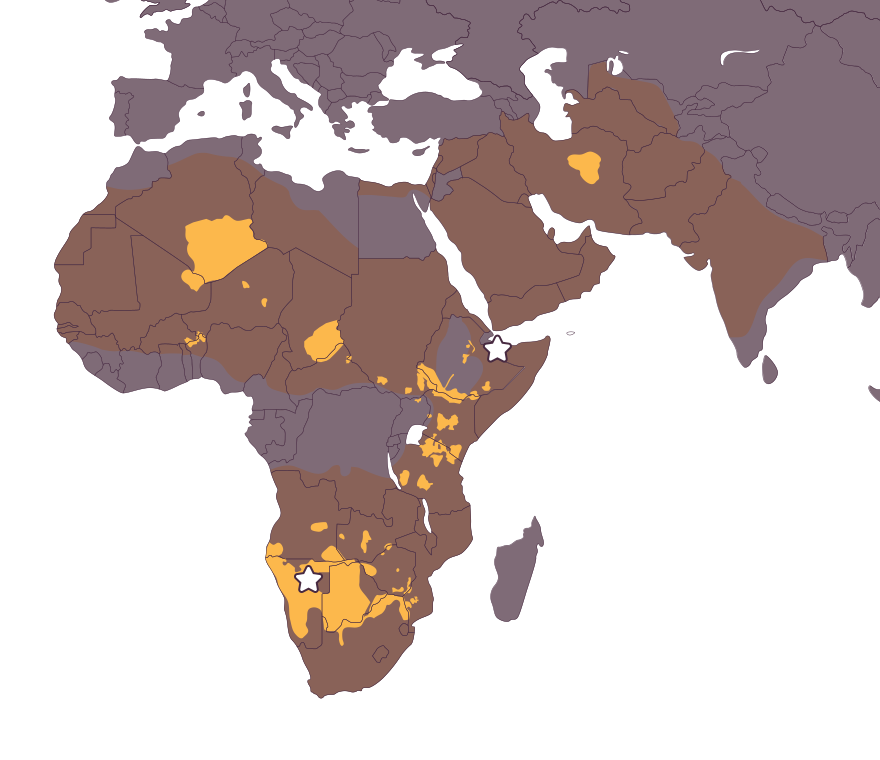
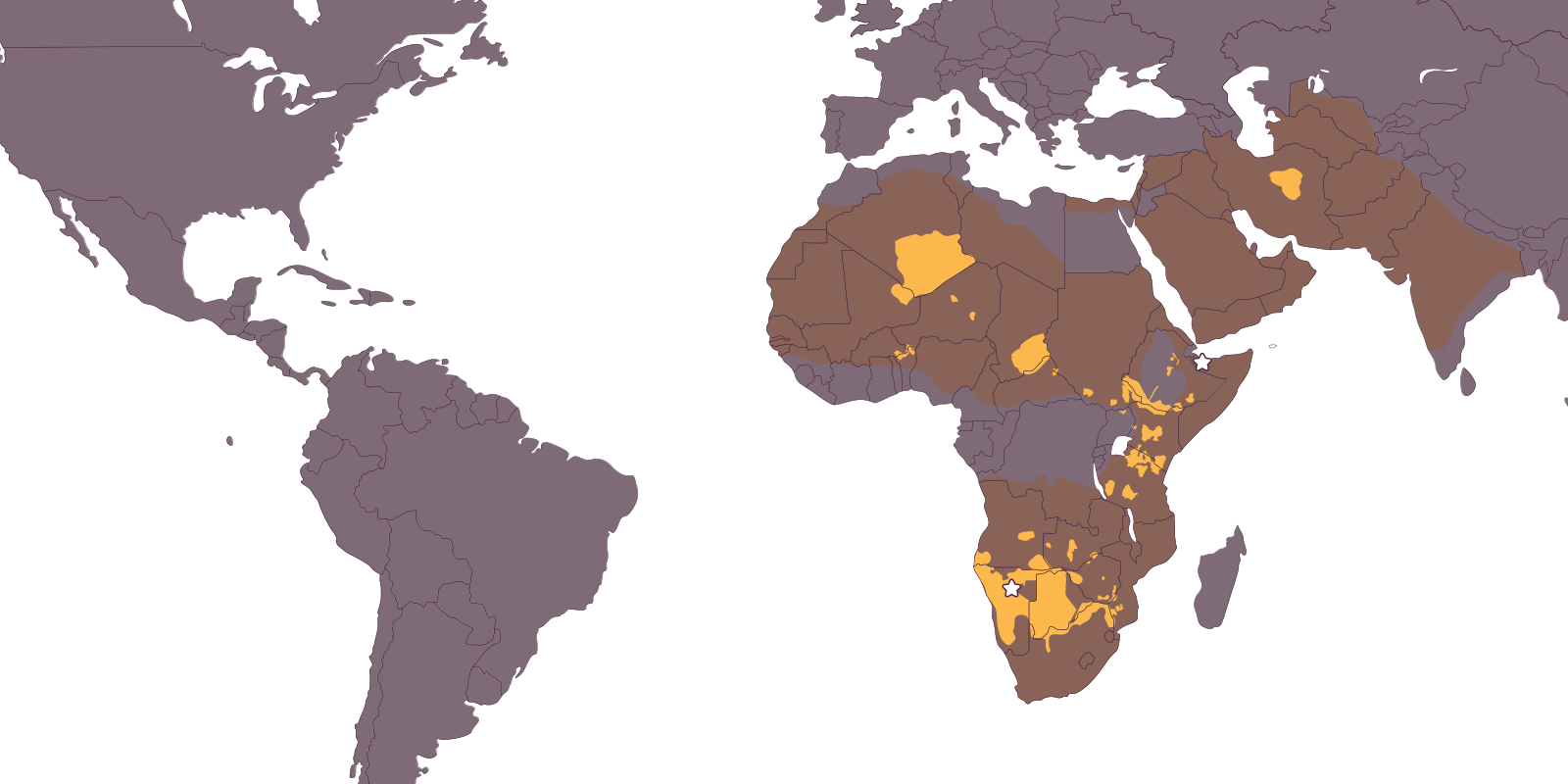
where is a cheetahs habitat |
| Answer: |
Our web site is full of information about the cheetah. Please see our section About the Cheetah on the left for answers to this and other questions. We ask everyone to please check our web site to make sure that the answers you are looking for are not already there. Thank you. |
| Question: |
posso partecipare alle vostre spedizioni? (Can I participate in your expeditions?) |
| Answer: |
For information, please visit our Volunteer section at http://www.cheetah.org/?nd=101. Thanks! |
| Question: |
I am doing a speech on cheetah's and I need to know some things. -First, who wrote the information under the catagory "About the cheetah" and then in the subtitle "Information"? (Shown on the right side of the page under "About the cheetah.") The page I need the author for is the one with the map on the top. I need the first and last name too PLEASE! -Next, I need the date that page was writen (published). If posible, the day, month and year, please. I need at least the month and the year. -And finaly, I need to now where the page was published, town and country please. That is all I need, I appresiate it so much. Please send me a response by at the latest, Wednesday Janurary 9th not after 6:00 pm and the earlyest, today. Thank you so much, I got mostly all my information on your site. Hannah |
| Answer: |
All the information on our web page was written by staff or volunteers of the Cheetah Conservation Fund, based on various scientific papers we have published, so there is not one person that can be attributed the specific pages you have mentioned. The same goes for dates. Our web page is constantly updated. To cite our web page as your source of information, you can do so as follows: Cheetah Conervation Fund. (Page title, e.g. About the Cheetah). [Online] Available (web address, e.g. http://www.cheetah.org/?nd=39), (date you looked at the information, e.g. January 8, 2008 if today). So it would look like this: Cheetah Conservation Fund. About the Cheetah. [Online] Avaiable http://www.cheetah.org/?nd=39, January 8, 2008. We hope this information helps. |